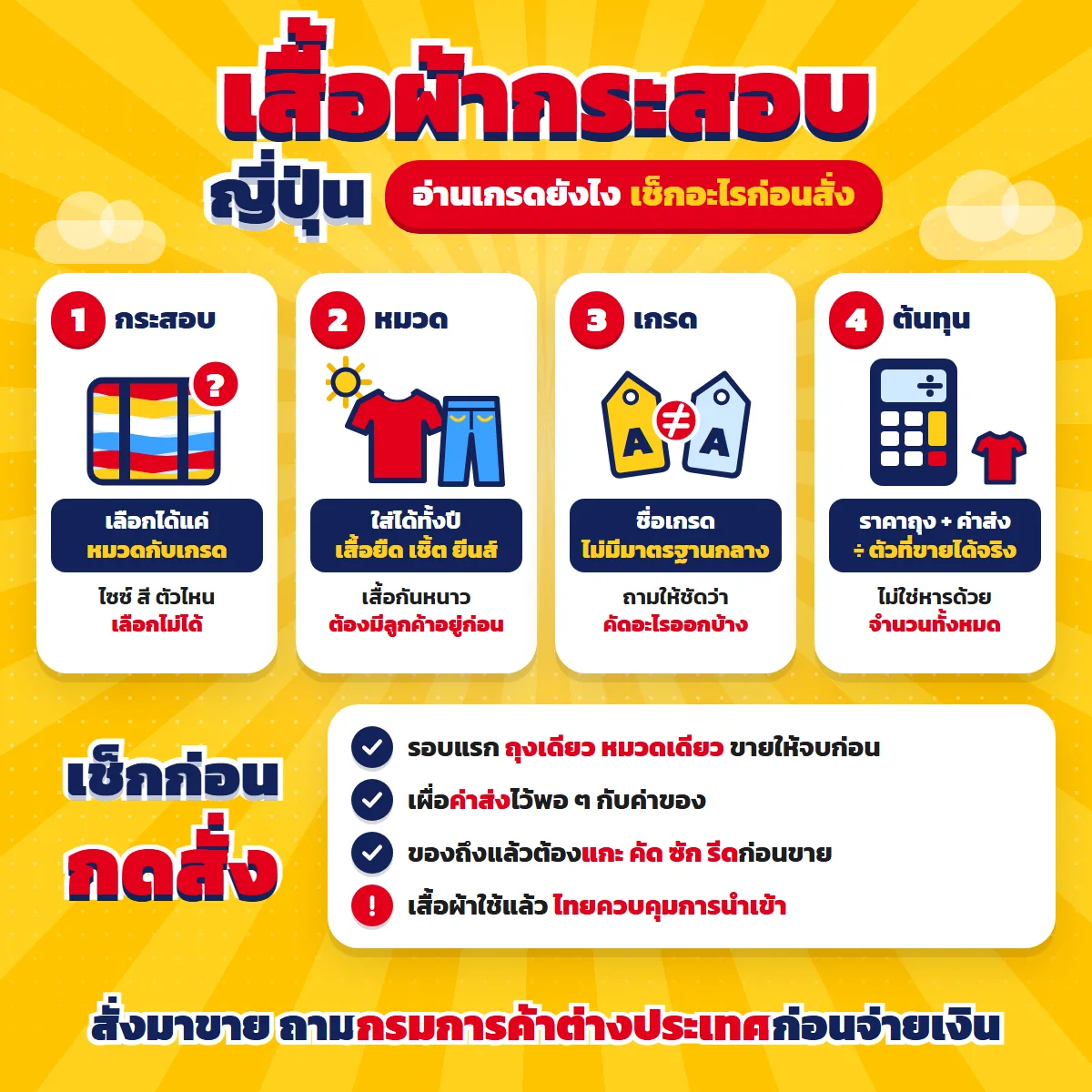
Japanese Clothing Bales: Reading the Grades and What to Check Before You Buy
The low price per garment is what gets people interested. The rest is which categories move in Thailand, what a grade does and does not tell you, and what a piece really costs once the unsellable share is in the sum.
Most people weighing up a first sack are not stuck on the price. They are stuck on not knowing how many pieces will actually sell once it is open.
The only things you get to choose before the money moves are the category and the grade, and between them they have already decided half of how the sack turns out.
How a bale differs from picking items one by one
A bale is clothing sorted at a Japanese grading house, then compressed and tied into a large sack under a category and a grade printed on the outside — winter outerwear, denim, knitwear. You choose the category and the grade. You do not choose which pieces, which sizes or which colours are inside.
Profit and loss sit with the whole sack: the pieces that sell well are the ones carrying the pieces that never move.
What moves here, and what needs a plan first
The first thing to plan around is the weather. Thailand is hot almost all year, while a large share of what sits inside a Japanese bale is winter outerwear — which sells only if you already reach customers packing for a cold trip. It is not a market to go looking for once the goods have landed.
Sizing is the other one. Clothing cut for the Japanese market runs smaller than the international size on the same label, so bigger customers are left with fewer options. The seasons do not line up either: stock leaves the grading house on their calendar, so it can arrive in a month when it cannot be sold and has to sit through a season.
What crosses between the two climates comfortably is anything worn year round — tees, shirts, denim. Vintage and Japanese denim have a following that does not care what season it is, though those buyers inspect a garment far more closely than a general customer.
Pick the category by who you can already sell to, not by the sack with the lowest price per kilo.
What a grade tells you, and what to ask beyond it
A grade describes how carefully the sack was gone through. It does not describe what is inside it — not the labels, not the sizes.
A higher grade means somebody genuinely went piece by piece and pulled out whatever was torn, stained, stretched or long out of style. A lower grade is cheaper because that pass was rougher. What you save at purchase does not disappear; it comes back as sorting work in your own shop.
Grade letters have no common standard, so an "A" from one supplier and an "A" from another cannot be lined up against each other. What can be compared is a straight answer to one question: what does that grade have removed from it? Keep the answer and hold the delivered sack against it. If the seller cannot say what was taken out, the letter on the sack means nothing.
The unsellable share belongs in the budget from day one
Every sack contains pieces that will not sell — prints nobody wants, stains that do not wash out. Anyone who prices as if every garment in the sack turns into money has lost before the sack is opened.
The arithmetic that works: take the price of the whole sack plus freight and divide it by the number of pieces you honestly expect to sell, not the total count. That is your cost per piece, and on a first sack it always lands higher than the estimate.
Bale-opening videos give a rough idea of what the goods look like, but the clips people post are the ones where the sack was good. Nobody films the quiet one.
Weight, freight, and the work waiting when it lands
Clothing is heavy and it takes up room, so freight on this category is a cost on the same scale as the goods themselves — and the one people get wrong most often. Heavy and not urgent is a sea problem — read how it is worked out on the shipping services page, and the other charges in the fee table, before deciding how many sacks to take.
Nothing is ready to sell the day it lands. It all has to be opened out, sorted, washed and pressed, the creasing from compression is worse than you expect, and the job takes more floor space than you set aside for it.
One last thing to settle before the first payment: used clothing is a controlled import category in Thailand, and whether a commercial import is allowed at all is an answer that has to come from the Department of Foreign Trade at the Ministry of Commerce — and it may be no. Once you have that answer and you deal with a Japanese seller yourself, the receiving side is covered in the guide to receiving and forwarding.
Frequently asked questions
Possibly — intent alone does not settle it. Used clothing is a controlled import category in Thailand, so intent is not where the line sits — volume and the way the import is arranged are looked at too, and a few personal items is not the same picture as a full sack.
For a commercial import, the office that decides whether your case is allowed at all is the Department of Foreign Trade at the Ministry of Commerce; it is not only a question of on what terms, and the answer may be no. Anyone ordering to resell should have that answer before any money is paid.
One sack, one category, sold through before you order again. The first round is how you find out whether that supplier's grade matches what was described, which sizes your customers actually take, and how long the back-of-house work really needs.
Send what the seller has quoted you over LINE: category, grade, quantity, approximate weight, sack dimensions and the seller's address in Japan.
Read next
- How to Forward Your Own Parcels from Japan to ThailandBought something in Japan yourself? Send it to our warehouse there, tell us the tracking number on the site, and we ship it home. Just follow the screenshots.

- Choosing a Japan Shipping Service: 4 Things to Check Before You PayEvery provider says fast, cheap and reliable. These four things you can verify yourself before a single baht moves — from the warehouse address in Japan to the terms on lost parcels.

- Shipping from Japan back to Thailand, by sea or by airCompare the two shipping modes, the transit times, and the shipping rounds we run
- Service fee and shipping rate tablesCheck the per-item service fee and the sea and air freight rates before you commit
Related keywords
- Japanese clothing bales
- used clothing bales from Japan
- opening a Japanese bale
Got a lot in mind and want a second opinion first?
Sign up and order from Japan yourself, or talk it through with an admin on LINE.