Choosing a Japan Shipping Service: 4 Things to Check Before You Pay
Every provider says fast, cheap and reliable. These four things you can verify yourself before a single baht moves — from the warehouse address in Japan to the terms on lost parcels.
Which Japan forwarder to use is not a question answered by a list of company names, because the list today is not the list in six months.
But anyone genuinely receiving parcels every day has certain things on hand, and an outfit that just opened to wait for transfers cannot produce them. All four checks below can be done from home, and they belong before the first transfer — after that, the leverage is on the other side.
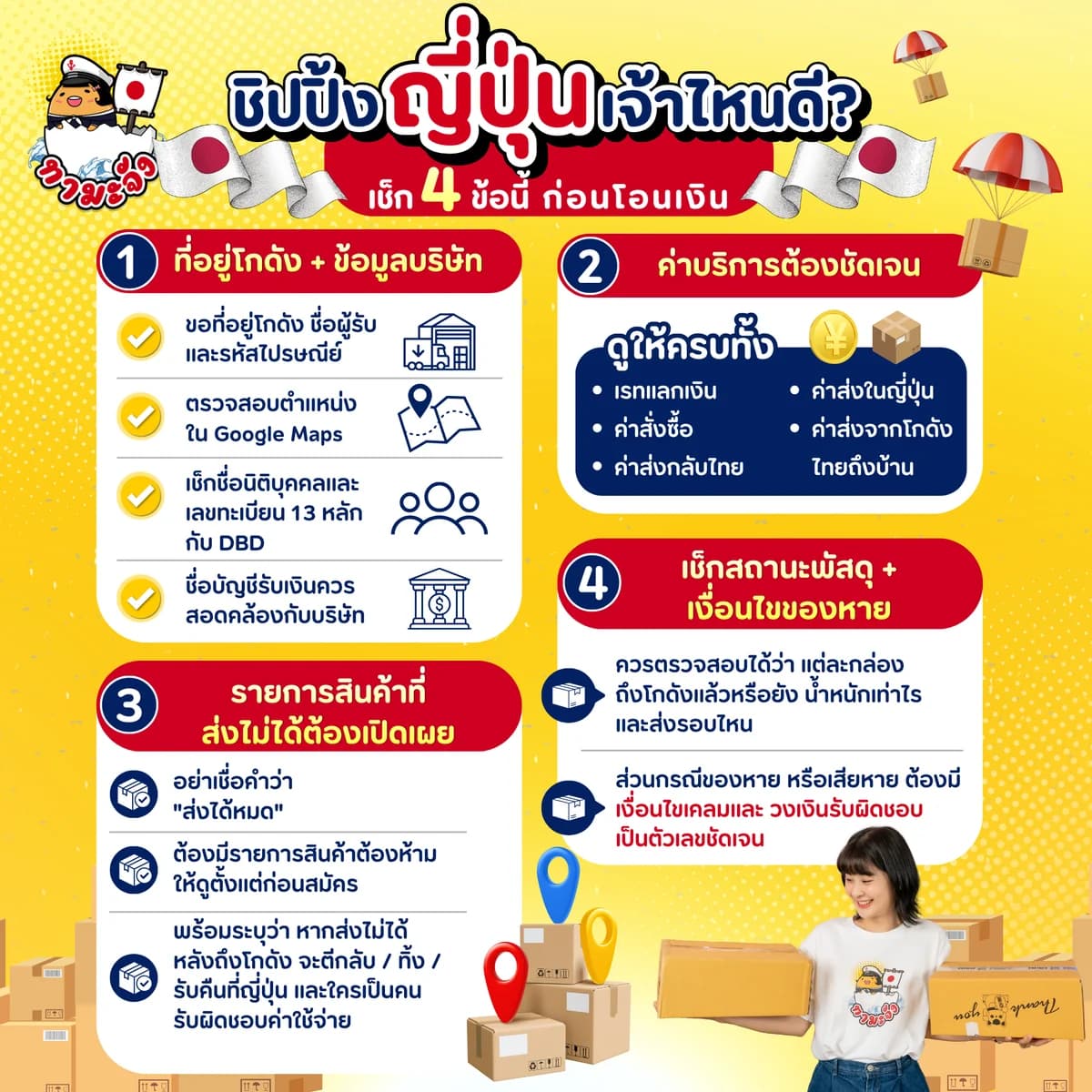
1. The warehouse address in Japan, the recipient name, and whose name is on the account
Ask for the Japanese warehouse address in writing, in Japanese and in English, postcode included. This is not a sincerity test — it is something you actually need, because when you order from a Japanese shop you are the one typing that address into the recipient field. A provider who cannot give you the address until you have paid a deposit is a provider with nothing yet to check. Drop it into Google Maps once while you are at it. An industrial area or a suburban commercial building is normal for this kind of warehouse — but if the pin lands on a residential condo, a convenience store, or nothing at all, ask about it first.
The address has to come with a recipient name or a code that is yours. One warehouse takes in hundreds of boxes a day, and what says whose box is whose is that line. If all you get is a bare address and "we'll know when it arrives", they have no way to match parcels to customers.
On the company side, ask for the registered name and the 13-digit registration number, then look it up on the Department of Business Development site: check that it exists, and that the bank account you are told to pay matches the registered name. That carries more weight than a follower count — the day something goes wrong, you can trace a registered company, not a LINE display name.
If you already buy from Japanese shops yourself and only need someone to receive and ship, those two are nearly all you need. That side of it is in the parcel forwarding guide.
2. Shipping costs stated clearly, with nothing buried
A rate table published on the site, readable without adding anyone on LINE, differs from a quote you have to ask for in one way that matters: a number published in one place applies to everyone equally, while a number given in chat can change every time it is asked for.
Look at how many routes that table offers, too. A provider running both sea and air lets you match the route to the goods — heavy and not urgent by sea, urgent or fragile by air — while one that runs a single route leaves you with no option the day your goods do not suit it. Each route should come with its own transit time.
But freight per kilo is one line among several. Before you decide, get all of them:
- the exchange rate used for the goods, and which day's rate applies
- the purchase service fee — flat per item, or a percentage of the price
- freight home, charged by weight or by box size, and the minimum charged
- domestic shipping inside Japan from the shop to the warehouse, the line most often left out
- delivery from the Thai warehouse to your door, and repacking if there is a charge for it
A provider who quotes a per-kilo rate and lets the rest surface once the goods are in Thailand is not cheaper — it just told you later. All five should be readable on one page before you decide: ours — how we price the goods, the fee per item and freight by weight — are on the fees page.
3. A list of what cannot ship, published before you sign up
Anyone shipping every day knows what the airlines and shipping lines will not pass, and writes that list down where you can read it before signing up — not once your box is already sitting in the warehouse. "We can ship anything" is more alarming than a two-page list of restrictions.
A restricted list comes from three sources at once: Thai law, the carrier's own air or sea cargo rules, and the conditions each company sets for its own route. Counterfeit goods fall under the first, lithium batteries under the second, and spirits or sake under the third — plenty of forwarders refuse them outright even though the law treats them as licensable rather than banned. A provider who knows the work can tell you which of the three your item falls under.
Ask the follow-up: if something reaches the warehouse and turns out to be unshippable, is it disposed of, returned, or held for you to collect in Japan — and who pays? A provider who has handled it before answers without pausing.
The kind of list you want to find before you order looks like this list of what cannot be shipped back to Thailand: named items, not a vague line about anything illegal.
4. Parcel status and loss terms you can check yourself
These two come from the same root: does the provider record goods box by box?
Ask whether, once your goods reach the warehouse in Japan, you can see for yourself how many boxes there are, what they weigh and which departure they are on — or whether you have to message and wait every time. A system you log into is not automatically the better provider, but it does mean parcels are recorded individually, which is the record that answers the question when one goes missing.
On loss and damage, look for it in writing before you commit: a stated liability cap, per box or per tracking number; a clear split between goods damaged before they reached the warehouse and goods lost after they arrived; and what evidence a claim needs. "We cover everything" said in chat and written nowhere is worth nothing.
Three of the four we publish on the site, readable before you sign up. Sea and air rates with transit times are on the shipping page; the registered company name, number and address sit at the bottom of the fees page linked above; and the liability cap on a lost parcel is written as a figure per tracking number in the forwarding guide.
The remaining one is the warehouse address, which we issue with your own recipient code once you have registered, because that code has to belong to your account alone — and the address for air freight is a different one, requested from an admin. If you are comparing several providers, put the same four questions to the others too.
Frequently asked questions
Not necessarily. What you pay is the item price times their exchange rate, plus the fee per item, plus shipping inside Japan, plus freight home. A provider with a low per-kilo rate and an exchange rate above everyone else's has taken the difference back on the first line. The honest comparison is to give each provider the actual item you intend to buy, ask for one total, and compare the totals.
Order one small, inexpensive item and watch a full cycle: the quote, the goods arriving at the warehouse, the parcel reaching your door. One complete cycle tells you more than ten reviews, because most reviews are written once the parcel has arrived, not when something went wrong.
Call your own bank, or Thailand's anti-online-scam hotline on 1441, as fast as possible — a freeze only works while the money is still there. Gather the transfer slips, the chat history and the destination account name and number while you wait. The important part: that first freeze is temporary, so the police report has to follow immediately, not in a few days, or the account is released and the money withdrawn. Reports are filed online at thaipoliceonline.go.th, the Royal Thai Police portal. If the recipient is a registered company, Department of Business Development records support the case.
Read next
- Who Tama-Chan isThe company behind the service, the team, and why customers have placed over 170,000 orders
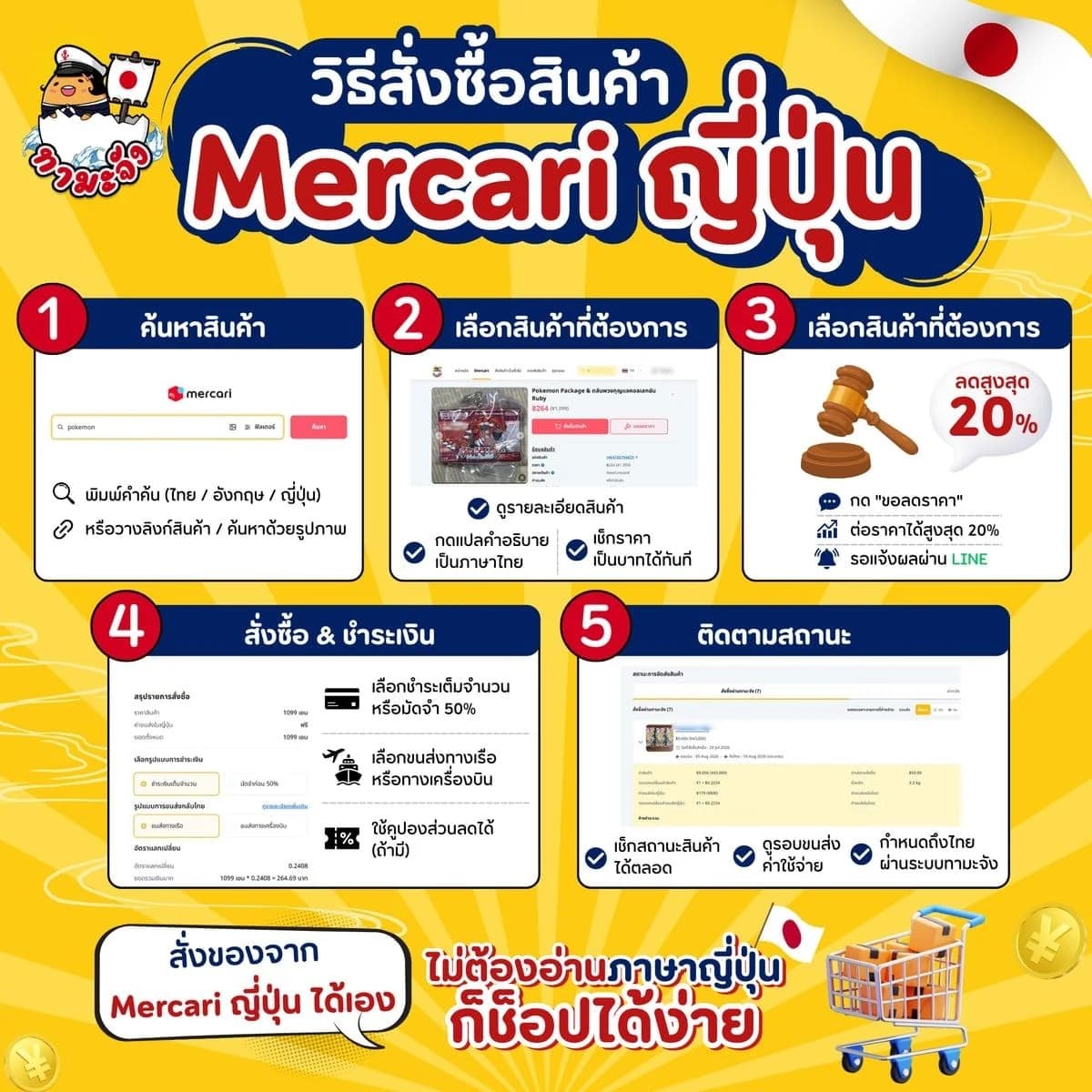
- How to Order from Mercari: Search, Haggle, Pay and TrackOrder from Mercari Japan yourself on Tama-Chan. No Japanese account needed: just follow the screenshots step by step.
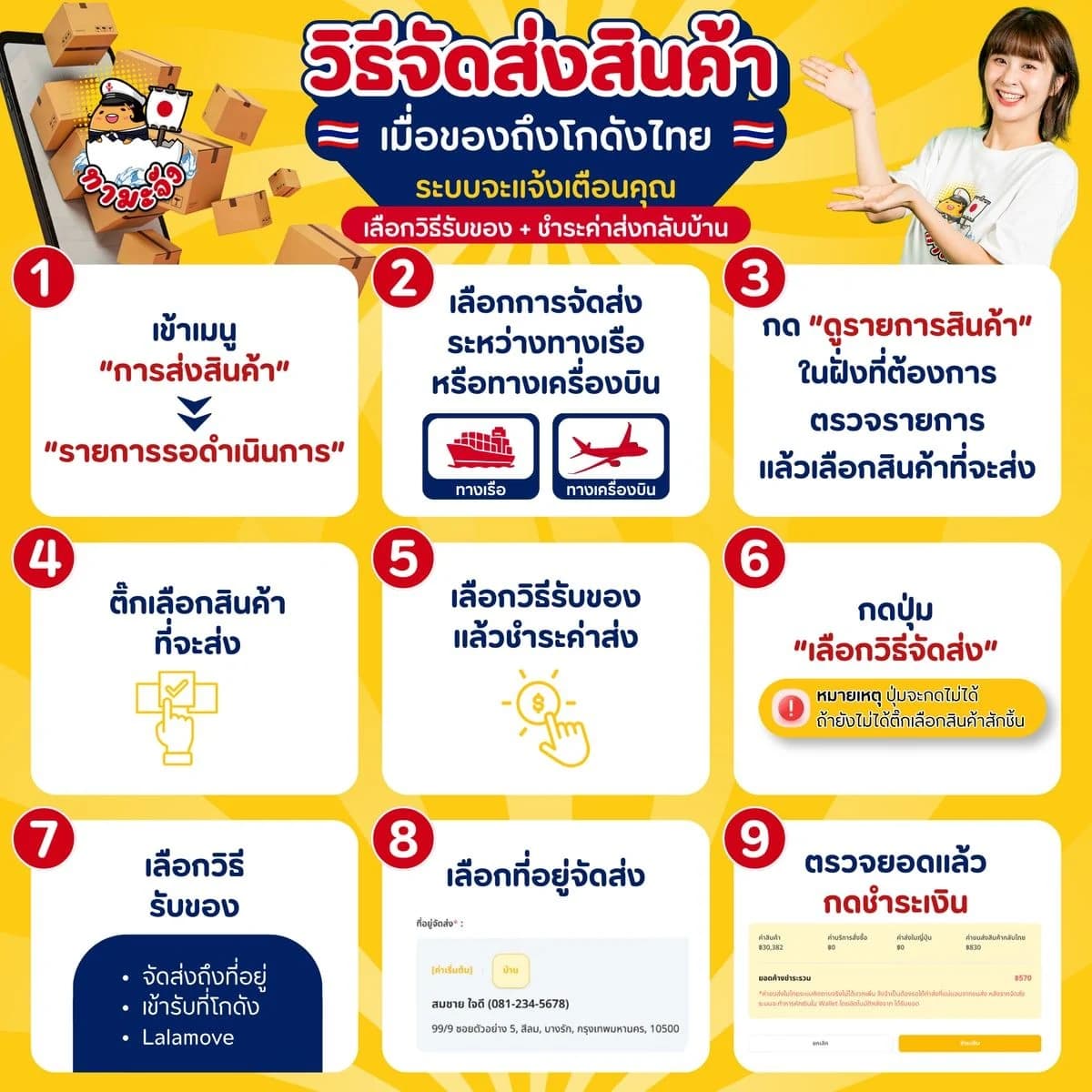
- Confirm shipping on Tama-Chan when your goods reach ThailandGoods at our Thailand warehouse? Arrange delivery yourself on the site: pick sea or air, choose how to receive them, and pay the shipping. Just follow the screenshots.
- Shipping from Japan back to Thailand, by sea or by airCompare the two shipping modes, the transit times, and the shipping rounds we run
Related keywords
- choosing a Japan shipping service
- comparing Japan forwarders
- trustworthy Japan forwarder
Found a provider that answers all four? Start here
Put the same four questions to us on LINE, or register and try one small order first.