Japanese Appliances Run on 100V: Using Them in Thailand
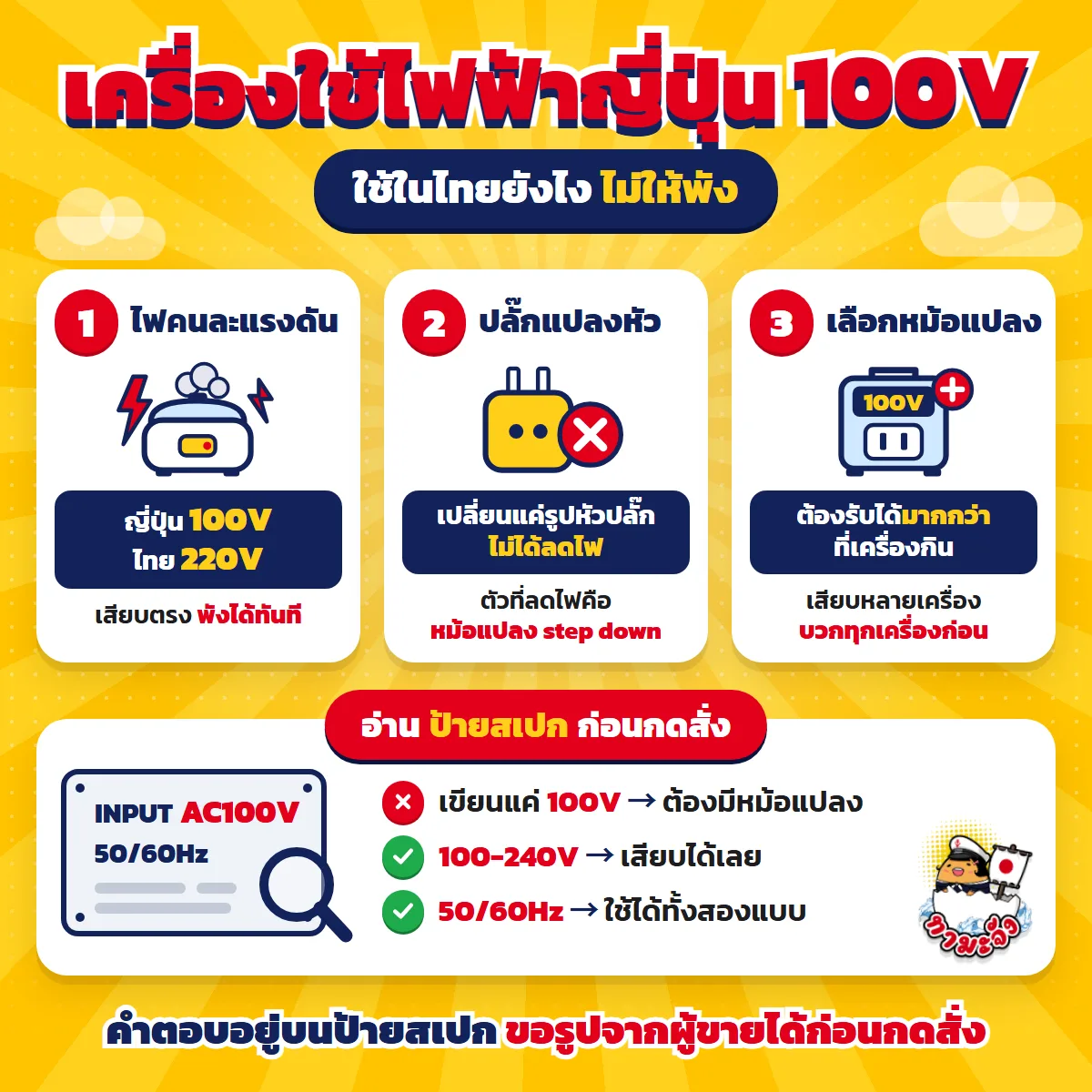
Japan's mains supply is 100V and Thailand's is 220V, and plugging one straight into the other can end the appliance on the spot. A plug adapter will not save it. The answer is on the rating plate, and you can ask the seller for a photo of it before you pay.
A rice cooker or a coffee machine ordered from Japan, plugged in at home for the first time, followed by a noise and a burnt smell. It happens more often than people expect, and not because the appliance was faulty. Japan supplies homes at 100V; Thailand supplies them at 220V.
All of this can be settled before you pay, and the thing that settles it is usually already in the photos the seller took.
100V against 220V: how far apart they are
Japan runs its household supply at 100V, the lowest of any country in general use. Thailand runs at 220V. Plug an appliance built for 100V straight into a Thai socket and it meets more than twice the voltage it was designed around.
Anything with a heating element or a motor - a kettle, a toaster, a hair dryer - rarely lasts a minute, and some die the instant the switch goes on. Things with a circuit board inside are sneakier: they can come up looking perfectly normal and then go quiet days later. That is worse, because surviving the first time convinces you there was never a problem.
A plug adapter is not a transformer
A plug adapter changes the shape of the pins so they fit the socket. It does not drop the voltage running through it by a single volt. This is where most appliances are lost.
What actually drops the voltage is a step-down transformer: it takes the 220V from your wall socket and gives the appliance 100V. It is a heavy box with sockets on it, not a small head you throw in a suitcase.
The confusion comes from both being sold as converters. The quickest way to tell them apart is the numbers printed on the thing: a transformer states what goes in and what comes out. No two sets of figures, no transformer.
The rating plate has the answer
Every appliance carries a rating plate, usually on the back or underneath. If it runs off a separate power adapter, the figures are printed on the adapter, not on the appliance. The line you want is the input line, the one starting INPUT or AC.
If that line says 100V and nothing else, this appliance needs a transformer. There is no way around it.
If it gives a range - 100-240V, for example - the power supply accepts anything in that range, so Thai mains is fine and only the plug shape is left. Laptop adapters, camera chargers and most recent portable players sit in this group.
Do not guess from the category, though. A model sold inside Japan and the same model sold elsewhere can ship with different power supplies. Only the plate settles it.
Listing photos often include the back of the unit already. If they do not, ask the seller to photograph the plate before you order - that one question ends the whole discussion. The same plate also carries the watt or amp figure you need for the next part.
Sizing the transformer
One principle: the transformer has to be rated above what the appliance draws, not level with it. What it draws is the figure on the plate you just read.
The headroom is there because anything with a motor or a heating element pulls far more the moment it starts than it does running. Vacuum cleaners, water pumps and fridges are all in that group. A transformer matched exactly to the running figure will cut out when you hit the switch, or run dangerously hot if it does not.
With several Japanese appliances, work them out one at a time. If they are going to sit on one transformer together, add them all up first rather than sizing for the hungriest one.
What a transformer cannot fix, and what not to buy at all
The first is frequency. Japan runs both 50Hz and 60Hz depending on the region - 50Hz in the east around Tokyo, 60Hz in the west around Osaka - while Thailand is 50Hz throughout. A transformer changes voltage only; it leaves the frequency alone. Appliances that keep time from the mains, or motors that turn in step with it, end up running off the mark. Most rating plates say 50/60Hz, which means either is fine. A plate naming one frequency on its own deserves a closer look.
The second is the plug. A transformer does not reshape the pins. Japanese plugs are two flat pins and go into almost any Thai socket, but a model with a third earth pin still needs an adapter in between.
The rest is a decision to make before you pay rather than after the box arrives. A power-hungry appliance needs a correspondingly large transformer, then there is the weight to ship home, then the fact that service centres in Thailand will not repair a model never sold here. Add those three up and some appliances were never worth it.
So check how freight is charged by weight and the list of what we cannot ship home before you order - plenty of appliances have a battery built in. For anything second-hand, read the condition the seller has declared as well; it describes the outside, not what the inside has been through.
Frequently asked questions
Read next
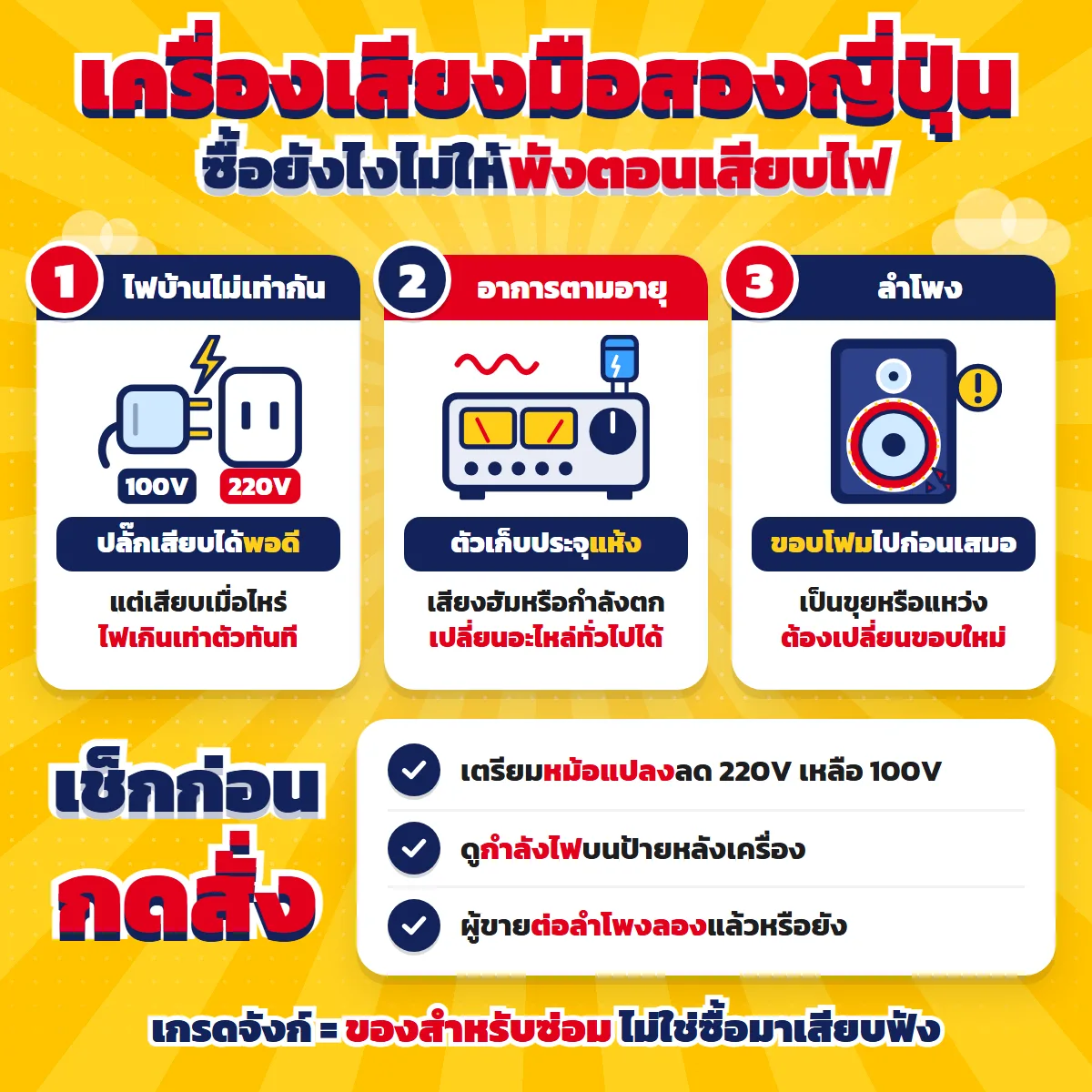
- Buying Second-Hand Japanese Audio Without Frying ItJapan built the golden age of hi-fi and most of it stayed there. But this gear is made for a 100V supply while our mains runs at 220V, and that has to be sorted out before you order.
- Second-Hand Japanese Game Consoles: Region Locks and WearConsoles that vanished from shelves here years ago still change hands in Japan every day. Three things to settle before you order: what region the software is, mains power at a different voltage, and the condition inside that no photo shows.

- How to Order from Mercari: Search, Haggle, Pay and TrackOrder from Mercari Japan yourself on Tama-Chan. No Japanese account needed: just follow the screenshots step by step.

- Service fee and shipping rate tablesCheck the per-item service fee and the sea and air freight rates before you commit
Related keywords
- Japanese appliances 100V
- using 100V in Thailand
- Japan step-down transformer
Looking for a Japanese appliance?
Search and order it yourself through Tama-Chan, or message an admin on LINE.